
How to Choose the Right Air Duct Cleaning Company in Black Rock
Ask any duct cleaning company in Black Rock to name the static pressure their vacuum pulls and whether they use contact or agitation cleaning for flex duct versus sheet metal. A legitimate operator answers without hesitation. A bait-and-switch operation changes the subject. That single exchange tells you more than any coupon, any star rating, or any promise made over the phone, and it’s the fastest way to separate a real contractor from a van with a shop vacuum and a laminated price sheet.
The spring coupon circuit in Black Rock is predictable. A flyer shows up offering a whole-house clean for a number that only makes sense if someone is spending twenty minutes per home. Understanding why that number is bait, in mechanical terms, is the most useful thing you can learn before you make a single call. If you’d rather skip the research and talk to someone who knows the answer, call (855) 337-1198.
Key Takeaways
- Legitimate duct cleaning is measured in cubic feet per minute and static pressure, not in bedrooms.
- Per-vent pricing with no system cap is the signature of a bait-and-switch operation.
- A real company will bring a camera in before quoting you and again when the work is done.
- NADCA membership sets a process floor; it does not guarantee the equipment or the local experience.
- Black Rock homes with retrofitted forced-air systems often need a company that knows hybrid ductwork, not just tract-home layouts.
Why is the $99 duct cleaning coupon in Black Rock a red flag?
Because it cannot cover the cost of doing the work correctly. Real duct cleaning requires a vacuum with enough airflow and negative pressure to pull debris out of the whole system, containment to keep that debris from settling back into your home, and equipment that agitates the duct surface so the dust actually moves. None of that is cheap to run, and no operator can lose money on a job and stay in business. The coupon isn’t a price. It’s an entry point.
What happens after the technician arrives is where the math catches up. In our experience across Black Rock, the low-ball quote grows once the crew is inside: sudden discoveries of mold, “needed” sanitizing treatments, per-vent charges that stack up room by room, and add-on fees that never appeared in the phone quote. The final invoice can land several times the teaser figure, and by then the equipment is already set up and the technician is already in your crawlspace.
The mechanical reason the number doesn’t work is straightforward. A proper clean uses professional equipment from brands like Rotobrush or Nikro, which are built for the airflow and containment standards that commercial HVAC contractors expect. A consumer-grade vacuum pulling whatever it can through a hose cannot generate the static pressure needed to lift settled debris from a full branch run. When you see an impossibly low number, you’re not seeing a bargain. You’re seeing a company that either can’t afford real equipment or plans to make its money elsewhere.
What three questions separate a real company from a bait-and-switch?
Ask these before you book, and listen for a direct answer. A company that knows what it’s doing answers in seconds. A company that doesn’t will pivot to price, scheduling, or “it depends.”
- What is your vacuum’s CFM and static pressure rating? CFM (cubic feet per minute) measures how much air the vacuum moves; static pressure measures how hard it pulls. Both matter for whole-system cleaning. If the person on the phone can’t tell you either number, they’re not running professional equipment.
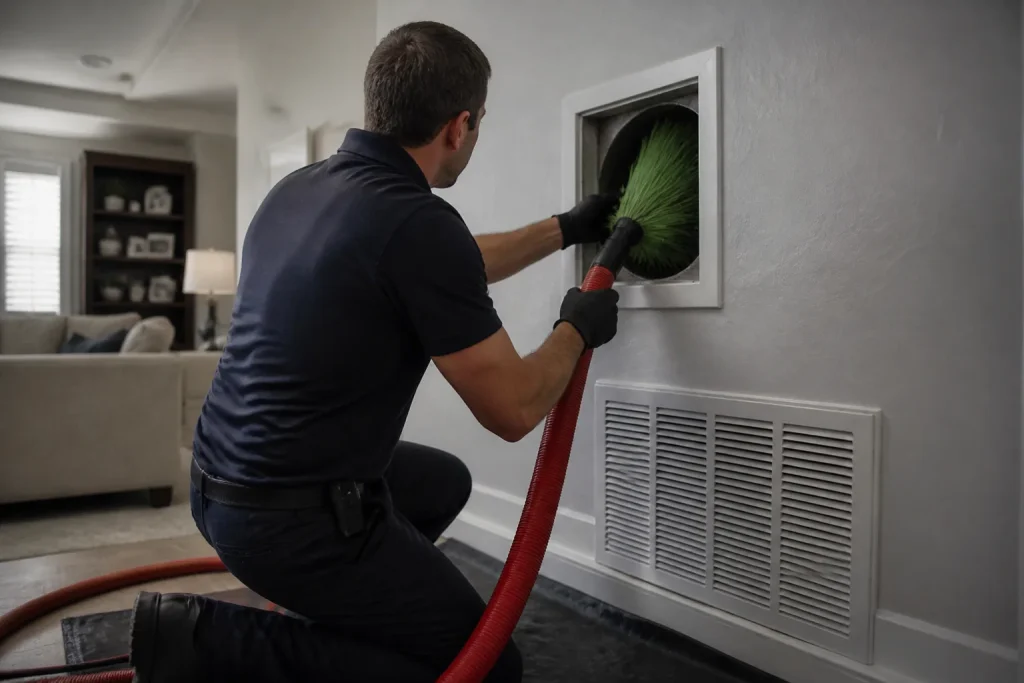
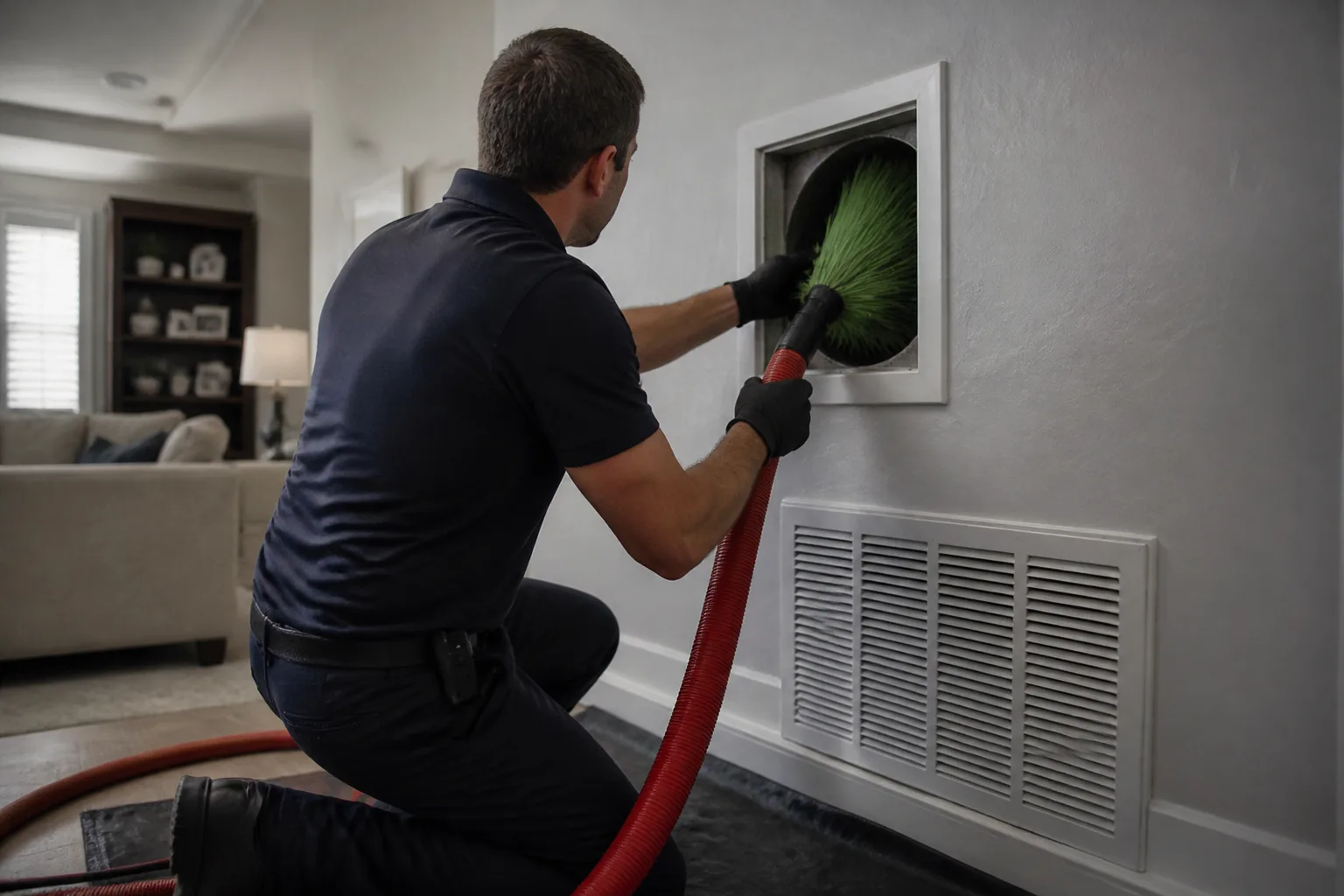
- Do you use a rotary brush, an air whip, or a skipper ball, and why for my duct type? Contact methods like rotary brushes and skipper balls scrub the duct surface and are suited to different duct materials. Air whips handle flexible and irregular runs that a brush can’t reach. A legitimate technician asks what kind of ducts you have before recommending a method. A generic “we use everything” answer without follow-up questions means they haven’t thought about your system.
- Do you clean the air handler and coil, or just the branch runs? Cleaning only the branch runs leaves the largest dust reservoir untouched. The air handler and evaporator coil are where debris accumulates and where a compromised coil quietly wrecks airflow and efficiency. A real scope of work names them.
These three questions work because they’re specific and they’re checkable. They’re also the questions a company experienced with Black Rock’s mix of housing stock should be able to answer about your specific configuration, not a generic one. If a technician sketches your system layout on the back of an invoice or describes how your duct runs connect, you’re talking to someone who has done this before.
What red flags should show up in the quote process?
The quote itself tells you a lot. Legitimate operators follow a predictable sequence: a phone conversation, an on-site inspection with a camera, a written scope of work before any equipment comes in, and a price agreed before the work starts. Anything that skips one of those steps is a warning.
- 1
Per-vent pricing with no system cap. If a company quotes by the vent, the incentive is to find more vents. A real operator quotes the whole system with a clear scope, then stands behind it.
- 2
No pre-inspection camera walk. If nobody wants to put a camera inside your ducts before quoting, the quote is a guess. The camera is also how you’ll know the work got done later.
- 3
No written scope of work before arrival. What’s included, what’s not, what happens if they find damage. If it isn’t written, it isn’t agreed.
- 4
Refusal to name their equipment. Companies confident in their tools name them. Rotobrush and Nikro aren’t secrets; they’re proof.
- 5
Pressure to sign today. Duct cleaning isn’t urgent. If you’re being rushed, the rush is for the rep, not for you.
In Black Rock, we’ve seen the housing stock catch out out-of-town operators. Cape Cods, colonials, and split-levels here were built across different decades, and the ductwork in each varies. A company that only runs tract-home layouts can miss a register or a return and leave half the system untouched. A scope of work that says “all supply and return runs, air handler, and accessible ducting” is a scope you can hold someone to.
Is NADCA membership proof a company is good?
No, but it’s a useful floor. NADCA (the National Air Duct Cleaners Association) sets process and training standards for the industry, and membership signals a company has committed to those standards. It does not certify equipment quality, it doesn’t guarantee the crew you meet is experienced, and it says nothing about how well they know the particular duct layouts in a specific neighborhood. Membership is a starting filter, not a verdict.
What it’s good for is screening. If a company can’t be bothered to maintain the basic industry standard, that’s a real signal. If they maintain it, you’ve confirmed the floor and can move on to the questions that actually differentiate operators: their equipment, their process, and their knowledge of your system.
Equipment and process are where we focus our own operation. Professional-grade tools from Rotobrush, Nikro, and Abatement Technologies do the work that consumer equipment can’t, and Abatement containment keeps the debris in the vacuum instead of settling back through the house. When we quote a job, the quote reflects what’s actually necessary to do it properly, not a number designed to get a foot in the door. For homeowners comparing options, that’s the difference worth paying attention to.
What should a post-cleaning report include in Black Rock?
Documentation, not a verbal thumbs-up. A legitimate cleaning ends with a report you can keep, and it should contain three things: before-and-after camera footage of the ducts, a written record of any damage found during the work, and a filter replacement recommendation tied to what was pulled from the system.
The before-and-after footage matters because it’s your only proof the work got done. It also gives you a baseline for the next cleaning. The damage record matters because ducts don’t only hold dust; they can have gaps, disconnected sections, or compromised joints that undercut the whole clean. If a technician finds a leak or a damaged section, the correct response is to fix or seal it, not to mention it and move on. We can clean, repair, and seal in one visit so nothing gets handed off or left for a second appointment.
Filter recommendation matters because it’s the piece homeowners actually control. What comes out of the system tells a technician what’s getting in, and a filter recommendation should follow from that observation, not from a generic “upgrade to the highest MERV you can find.” We carry Honeywell and Aprilaire air quality products for homeowners who want to address filtration beyond the standard slot, and we apply Guardsman sanitizing treatments after cleaning when the situation calls for it.
What the report should not be is a sales pitch. If the afternoon ends with a printed health report and pressure to schedule a treatment you didn’t ask about, you’ve been sold to, not cleaned for.
Why does Black Rock housing stock matter for duct cleaning?
Because a lot of it wasn’t designed for forced air in the first place. Black Rock has a significant number of older homes where cast-iron radiator systems were the original heat source and forced-air ductwork was retrofitted later, often through attic space, closets, and soffits that were never intended to carry ducts. That produces non-standard routing: tight transitions, unusual return locations, flexible connections where rigid ducting would normally go. It’s not a problem, but it’s a specific situation that rewards experience.
A company that only cleans tract-home ducts walks in, sees a hybrid retrofit, and either misses runs or spends the afternoon improvising. A company that’s seen the configuration before knows where to look and which equipment handles the tight transitions. That’s not something you can check off on a certification. It’s local experience, and it’s worth asking about directly.
When to call a pro
Cleaning yourself with a shop vacuum and a hose is a losing proposition on a system this size; you’ll stir up more than you remove. Call a professional when you notice visible dust puffing from a register, a persistent musty smell that returns after filter changes, a recent renovation that left construction debris in the system, or a household member with allergies who’s seen no improvement from filtration changes. If you’re not sure which service you need, our air duct cleaning page walks through what a standard clean covers, and our HVAC cleaning page explains the difference between duct cleaning and cleaning the air handler and coil.
Ductwork safety matters too. If a technician finds disconnected sections, gaps, or compromised joints, sealing them is part of solving the problem rather than a separate job handed to someone else. And separate from ductwork entirely, if you haven’t had your dryer vent cleaning done in years, that’s a fire-safety service worth scheduling while the crew is already on site.
The Bottom Line
The right company in Black Rock isn’t the most expensive one and it isn’t the one with the flashiest coupon. It’s the one that answers the three technical questions without flinching, brings a camera before quoting and after cleaning, writes a scope before anyone shows up, and can handle the retrofit ductwork a lot of the housing stock here actually has. If a company can’t do those things, the coupon price isn’t a discount. It’s an entry fee.
Our technicians have up to 11 years of experience with exactly this range of systems, and we use professional-grade equipment from Rotobrush, Nikro, and Abatement Technologies, not consumer vacuums. We clean, repair, seal, and sanitize with the same team so nothing gets handed off. If you’re in Black Rock and want a straight answer about your system, Air Duct Cleaning Black Rock offers free estimates.
Frequently Asked Questions
A whole-system clean is priced per job, not per vent, and the exact figure is set by a written estimate after we’ve inspected your ducts. We don’t quote from a flyer or a phone number, because the price depends on your system’s configuration, the number of runs, and whether any repair or sealing is needed. Call (855) 337-1198 for a free estimate.
Because they don’t cover a whole-system clean. The low number is an entry price that grows once the technician is on site, usually through per-vent add-ons or treatments you didn’t ask for. Real cleaning requires professional equipment with the airflow and static pressure to pull debris from the full system, and that costs real money to run. The honest price is higher up front and stays put.
Ask for before-and-after camera footage of your ducts and a written record of anything found during the clean, including any damage. A real operator documents what they did. A bait-and-switch operation shows up, runs a hose for twenty minutes, and hands you a bill. If they can’t show you the inside of your ducts both before and after, the work isn’t verified.
Most homes don’t need it on a schedule. A household with pets, recent renovations, allergy sufferers, or someone who’s just moved in may benefit sooner; a home with none of those factors can go years between cleanings. If you’re unsure, a camera inspection will tell you more than a rule of thumb. Call (855) 337-1198 and we’ll take a look before recommending anything.
Written by the team at Air Duct Cleaning Black Rock.
Need Air Duct Cleaning Help?
Call Air Duct Cleaning Black Rock - the local pro we connect you with is licensed and insured, here with fast help in Black Rock.
(855) 337-1198